
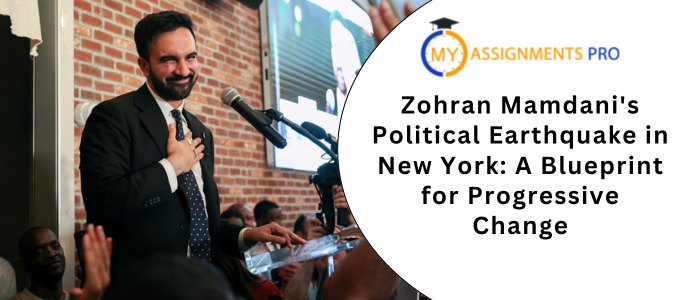
In a political landscape often dominated by the same old faces and the power of big money, Zohran Mamdani’s stunning win in New York City’s Democratic primary marks a turning point—not just for the city, but for progressive movements across the globe, including here in Australia.
For many Australians watching from afar, the parallels are striking. Much like in Australia, cost-of-living pressures, housing stress, and political disenchantment have created fertile ground for bold, values-driven leadership. Mamdani, a 33-year-old state legislator from Queens, offered New Yorkers exactly that—and they responded with overwhelming support.
An Unlikely Challenger with a Grounded Message
Facing off against political heavyweight and former New York governor Andrew Cuomo, Mamdani's campaign looked like a David versus Goliath battle. Cuomo, attempting a political comeback after a fall from grace, had the backing of powerful billionaires like Michael Bloomberg and Bill Ackman, and massive funding from corporate donors and super PACs. It was a classic top-down campaign, relying on name recognition and establishment endorsements.
Mamdani, by contrast, built a grassroots machine. His campaign zeroed in on the everyday struggles of working-class New Yorkers—rising rent, expensive groceries, unaffordable childcare, and decaying public transport. These are issues that Australians can deeply relate to, especially in cities like Sydney and Melbourne where the cost of living is spiralling.
But Mamdani’s appeal went far beyond his policy platform. He brought something rare to politics: authenticity. With clear, charismatic communication and a deep sense of purpose, he cut through the noise. While critics tried to dismiss him as just another “Muslim socialist” or push divisive narratives around identity or Israel, Mamdani refused to be baited. Instead, he stayed focused on what mattered to voters—making life better for ordinary people.
Cuomo’s Misstep: A Warning for Political Elites
Cuomo’s campaign strategy felt out of step with the times. He didn’t embrace the new ranked-choice voting system, failed to build alliances—even among centrists—and came across as someone more interested in restoring his own image than addressing the real concerns of New Yorkers. His run felt like a vanity project, and voters saw through it.
Australians might recognise a similar pattern in recent politics: seasoned politicians misreading the public mood and underestimating grassroots movements. Just as we've seen with the rise of independents and minor parties in federal and state elections, voters are no longer satisfied with business-as-usual.
The Power of People: Mamdani’s Campaign Was Built on Community
Mamdani’s victory wasn’t just about smart messaging—it was about movement-building. His campaign leaned heavily on volunteers, many aligned with the Democratic Socialists of America (DSA), a group not unlike Australia’s Greens or even some local activist collectives. It wasn’t about flashy ads or PR stunts; it was about talking to voters, listening to their concerns, and offering tangible solutions.
What’s more, nearly a quarter of early voters in the primary were casting their ballots for the first time. That’s the real revolution: bringing new voices into the democratic process. It’s something Australian progressives are striving to replicate, especially among young and disengaged voters.
And Mamdani’s reach extended beyond the usual left-wing enclaves. He won support in neighbourhoods that had shifted rightward in the 2024 U.S. presidential election. In many ways, this shows that progressive politics—when focused on real-world issues—can bridge ideological divides. It’s a lesson Australian politicians would do well to study.
A Broader Coalition, A Smarter Strategy
Another key to Mamdani’s success was unity among progressives. New York City Comptroller Brad Lander, a centrist-leaning progressive, didn’t just run his own campaign—he also cross-endorsed Mamdani. This wasn’t about ego; it was about strategy. The message was clear: defeating Cuomo mattered more than individual ambitions.
In Australia, where progressive parties and independents sometimes split the vote, Mamdani’s coalition-building serves as a valuable case study. Unity, when rooted in shared values, can be a powerful force against well-funded, establishment candidates.
Voters Chose Hope Over Fear
Cuomo’s camp tried to stoke fear—warning of rising crime and antisemitism if Mamdani were elected. But voters didn’t buy it. They looked around, saw that their everyday lives weren’t improving under the status quo, and opted for change. This echoes what we’ve seen in Australian electorates where climate inaction, housing inaccessibility, and political scandals have driven voters away from major parties.
Mamdani also managed to reframe democratic socialism—not as an extreme or fringe ideology, but as a common-sense approach to governance. He spoke directly to working people, including those who’d voted for Trump, showing that progressive policies can have broad appeal when presented with clarity and compassion.
The Road Ahead: Challenges and Promise
Winning a primary is one thing; governing effectively is another. Mamdani now faces a bigger test in the upcoming mayoral election, where he could face off against both current Mayor Eric Adams and a possibly re-energised Cuomo.
Australians have watched similar progressive victories—like those of Sally Capp in Melbourne or Clover Moore in Sydney—only to see these leaders struggle with entrenched interests, administrative inertia, and high expectations. In the U.S., Chicago’s Brandon Johnson is a cautionary tale of a left-leaning mayor stumbling due to political resistance and management issues.
For Mamdani, success will mean combining bold vision with pragmatic governance. Fortunately, he can look to historical examples—like Bernie Sanders’s tenure in Burlington, Vermont, or the “sewer socialist” legacy in Milwaukee. These models show that progressive governance can be competent, transparent, and widely popular.
A New Political Chapter
Mamdani has the chance to do something rare: redefine what political leadership looks like in a major city. If he can turn campaign energy into policy action—building affordable housing, expanding public services, and revitalising New York’s infrastructure—he could inspire a new wave of progressive politics not just in America, but globally.
His platform—focused on abundance, fairness, and public investment—isn’t radical in principle. What’s radical is how it excites and empowers people who had given up on politics altogether.
For Australian progressives, Mamdani’s campaign offers a template: lead with values, organise locally, speak plainly, and never underestimate the public’s hunger for real change.
As New York votes ripple across the globe, Zohran Mamdani’s message lands loud and clear in Australia: political revolutions don’t require pitchforks or chaos—just purpose, people, and persistence.
Affordable and Trusted Assignment Help Tailored for You
Facing tight deadlines or complex assignments? My Assignments Pro provides reliable, stress-free assignment help to support your academic success. Our experienced writers deliver high-quality, fully customised, and plagiarism-free work that aligns with university standards. Whether you're studying business, law, nursing, finance, IT, or any other discipline, we offer expert assistance across all subjects. Enjoy affordable pricing, timely delivery, and special discounts on bulk orders. From essays and case studies to detailed reports and technical projects, our comprehensive assignment help services are designed to guide you every step of the way.
Source

Mitchell Renshaw
Mitchell is a seasoned Ph.D. scholar with extensive expertise gained through years of rigorous research, publication, and teaching experience. He brings a wealth of knowledge and analytical skills to tackle complex academic challenges. His work is dedicated to delivering innovative solutions, advancing knowledge, and promoting academic excellence. Proficient in research methodology, data analysis, and scholarly writing, Mitchell has contributed to peer-reviewed journals and mentored students to achieve academic success.